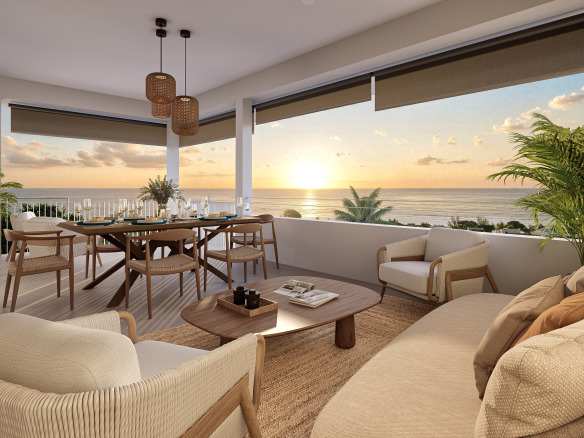
Off-market property in Mauritius is property that is for sale but never publicly advertised: no portal listing, no signboard, no public price. The seller shares it privately, through a trusted agent, with a small number of qualified buyers. The legal process does not change: a foreign buyer still purchases through an approved EDB scheme, passes identity and source-of-funds checks, pays 5% registration duty and completes before a Mauritian notary. What changes is how the property is found, priced and negotiated.
At the top of the market, beachfront villas, estate homes and resale units in mature IRS and RES developments are often sold quietly, because their owners value privacy more than exposure. For buyers, the portals show only part of the market.
This guide explains why sellers and buyers choose private sales, the trade-offs, the legal framework, how to check a price and how the process runs with LIVERIA. This guide was updated on 20 September 2026.
Off-market property in Mauritius: key facts
- Definition: an off-market (or “pocket”) listing is offered privately to selected buyers instead of being advertised on portals or social media.
- Same legal rules: non-citizens can still buy residential property only through EDB-approved routes: PDS, IRS, RES, the Smart City Scheme, and G+2 apartments priced at MUR 6 million or more.
- Resale notice: an owner in an IRS, RES or PDS project must notify the EDB in writing within 30 days prior to a sale, and the buyer applies with KYC documents and a MUR 25,000 fee.
- Buying costs: budget 7% to 8% over the price, including 5% registration duty and notary fees of about 1% to 2%.
- Seller costs: 5% land transfer tax, plus a 10% duty on residential property on State land or Pas Géométriques transferred to a non-citizen (promises of sale signed before 19 June 2026 are exempt).
- AML checks apply: real estate agents are reporting persons under the Financial Intelligence and Anti-Money Laundering Act 2002 (FIAMLA), supervised by the Financial Intelligence Unit.
- Agent registration: under the Real Estate Agent Authority Act 2020, no person may act as a real estate agent unless registered with the REAA. Registration opened on 1 August 2026.
What does off-market mean in real estate?
An off-market sale is a private sale. The property is genuinely available, but the agent presents it directly to buyers who match the brief and have shown they are serious. The related terms differ slightly:
- Off-market: never advertised at all. Only the agent, the owner and pre-qualified buyers know it is for sale.
- Pocket listing: the agent holds a signed mandate but keeps the listing “in the pocket”, sharing it only with its own buyer network.
- Pre-marketing: a property tested privately for a few weeks before a possible public launch.
Off-market does not mean informal. A proper private sale uses a written mandate, a promise of sale, EDB approval for non-citizen buyers and a notarial deed, exactly like a public sale.
Why do sellers in Mauritius choose to sell off-market?
- Privacy. Owners of prime villas rarely want their home, interiors or price on the internet, or strangers at the gate.
- Testing the price. A seller can test a figure with a handful of qualified buyers. If the response is weak, nothing needs to be reduced in public.
- Avoiding days-on-market stigma. A property that sits on portals for months, or visibly drops its price, loses negotiating power.
- Ultra-high-net-worth owners. Family offices and UHNW owners want vetted buyers, a non-disclosure agreement and few viewings.
- Timing. Some owners are open to the right offer without actively selling.
Why do buyers look for off-market property in Mauritius?
- Access. Some of the most sought-after homes never appear on a portal.
- Less competition. A property shown to 3 qualified buyers is negotiated very differently from a property shown to 300 enquiries.
- Discretion. Many buyers prefer that nobody knows they are buying, or where.
The honest trade-offs
- Less price transparency. There is no public market test of the asking price, and some private sellers ask more, not less, because the property is scarce.
- You need an independent view of value: comparables, a valuation report and an agent who will say when a price is too high.
- Smaller choice. Private stock arrives irregularly, so patience and a clear brief matter.
On-market vs off-market: how the 2 routes compare
| Factor | On-market (public listing) | Off-market (private sale) |
|---|---|---|
| Visibility | Portals, social media, signboards | Shared privately with pre-qualified buyers |
| Buyer competition | Open to anyone who enquires | Limited to a small, vetted group |
| Price transparency | Asking price public, history visible | Price disclosed privately, no public record until the deed |
| Seller privacy | Low | High |
| Information release | Photos and details upfront | Often after NDA and proof of funds |
| Negotiation | Can involve several bidders | Usually 1 to 1, calmer pace |
| Legal process | EDB approval, KYC, notary, 5% duty | Identical: EDB approval, KYC, notary, 5% duty |
| Main risk for buyers | Overpaying in a bidding situation | Overpaying without a market test |
How does off-market property in Mauritius work in practice?
No multiple listing service
Mauritius has no multiple listing service. Listings are fragmented across agencies, developers and private owners, and the same villa can appear on several portals at different prices, or not at all. That fragmentation is why off-market sales are common here: the market runs on relationships.
EDB rules still apply to foreign buyers
A non-citizen can buy residential property only through the approved routes, and the property must already sit within an approved scheme. For a resale in an IRS, RES or PDS project, the owner notifies the EDB before the sale, and the buyer applies with passport, birth certificate, KYC documents and the presale contract. A qualifying purchase of USD 375,000 or more still carries a residence permit for the buyer, spouse and children under 24. Our guide to foreign property ownership rules in Mauritius sets out every route.
Proof of funds, KYC and AML
Expect to be asked who you are and where your money comes from before you see the address. Real estate agents, land promoters and property developers are reporting persons under FIAMLA 2002, and the FIU supervises their compliance. Registered agents must also appoint a Money Laundering Reporting Officer and a compliance officer as part of REAA registration. A serious agent will ask for a passport, proof of address, proof of funds and the source of wealth. Our guide to the best real estate agency in Mauritius explains what to ask any agent in return.
NDA and confidentiality
Many private sellers require a non-disclosure agreement before releasing the address, plans, price or photographs.
Due diligence and the notary
Due diligence is the same as for any purchase: title and land tenure (freehold, or leasehold on State land or Pas Géométriques), EDB scheme status, building permits, syndic accounts and any charges registered on the property. Under EDB guidelines for non-citizen buyers, the purchase price is paid in foreign currency to the notary’s account, and the notary registers the deed. Budget 7% to 8% over the price for duty, notary and transfer costs, as set out in our guide to the cost of buying property in Mauritius.
How to check an off-market price in Mauritius
The missing market test is the biggest risk in a private sale. Close the gap with 4 checks.
- Comparables. Recent sales and asking prices in the same development or area, adjusted for size, view, condition and tenure.
- An independent valuation report from a qualified valuer who does not work for the seller.
- Official market context. Statistics Mauritius publishes a Residential Property Price Index (2019 = 100). It stood at 240.9 in Q1 2026, up 1.0% year on year, after a peak of 247.8 in Q2 2025. It is weighted towards standard local transactions, with a lower share of higher-end properties, so use it for direction, not for pricing a prime villa.
- Regional ranges for comparable property.
These are indicative ranges from LIVERIA inventory as at September 2026:
| Region | Indicative range | Median |
|---|---|---|
| North (Grand Baie, Mont Choisy, Pereybere) | EUR 190,000 to EUR 3,100,000 | About EUR 850,000 |
| West (Black River, Tamarin, Le Morne) | EUR 285,000 to EUR 5,350,000 | About EUR 1,180,000 |
| East (Belle Mare, Beau Champ) | EUR 500,000 to over EUR 6,000,000 | Not published |
| Centre (Moka, Ébène) | From about EUR 135,000 | Not published |
If an off-market price sits well above comparable public listings, ask what justifies the premium: a freehold beachfront title, a rare plot, a finished home. For how each coast behaves, see our guide to the best regions to buy property in Mauritius.
How to buy off-market with LIVERIA: step by step
- Brief. Purpose, region, property type, budget, timing and whether you need a residence permit.
- NDA and proof of funds. We complete KYC and confirm funds, so owners will release information to you.
- Curated shortlist. Matching private properties, with scheme, tenure, syndic charges and price.
- Viewings. In person or by private video, arranged discreetly.
- Negotiation. We test the price against comparables and negotiate price and terms.
- Due diligence. Title, tenure, permits and EDB status, checked with your lawyer and the notary.
- Notary. Promise of sale, EDB application, funds to the notary’s account, deed and handover.
Owners who do not live on the island can then use our managed rental service. Our comparison of a managed lease versus DIY letting shows what that involves.
How to sell your property off-market with LIVERIA
For owners who want to sell without a public campaign, we work on a confidential mandate:
- Written mandate setting out the price strategy, fee, confidentiality terms and the scope of disclosure you approve.
- Pricing based on comparables, with an honest view on whether a private sale or a public launch will do better.
- Buyer vetting: only buyers who have passed KYC and shown proof of funds see details, and only after signing an NDA.
- Controlled viewings at times that suit you, with no public photos and no signboard.
- EDB and notary coordination, including the 30-day notice to the EDB for scheme property.
Frequently asked questions
What is an off-market property?
An off-market property is a home that is genuinely for sale but not publicly advertised. The seller shares it privately through an agent with a few qualified buyers, usually after an NDA and proof of funds. The legal process, including EDB approval for foreign buyers, KYC checks and the notary, is the same as for a public sale.
Can foreigners buy off-market homes in Mauritius?
Yes, provided the property falls within an approved EDB route: PDS, IRS, RES, the Smart City Scheme, or a G+2 apartment priced at MUR 6 million or more. A private sale does not bypass these rules. The buyer applies to the EDB with KYC documents and a MUR 25,000 processing fee, and a qualifying purchase of USD 375,000 or more carries a residence permit.
Are off-market properties cheaper?
Not necessarily. Less competition can give a buyer more room to negotiate, but some private sellers ask a premium because their property is scarce and there is no public market test. Check every off-market price against comparables, an independent valuation and regional ranges. A good agent should tell you when a private asking price is too high, not only when it is attractive.
What is a pocket listing?
A pocket listing is a property an agent holds under a signed mandate but keeps out of public marketing, sharing it only with buyers in its own network. Sellers use it for privacy, to test a price quietly or to avoid a long public history on portals. For buyers, pocket listings are reached only by being known to the right agent with a clear brief.
What documents do I need to view off-market properties?
Expect to provide a passport, proof of address and proof of funds, and to explain the source of your wealth. Many sellers also ask for a signed non-disclosure agreement before releasing the address, plans or price. These checks reflect Mauritian anti-money laundering law, under which real estate agents are reporting persons supervised by the Financial Intelligence Unit.
How long does an off-market purchase take in Mauritius?
The search depends on how often matching private stock appears, which is irregular. Once a property is agreed, the normal process follows: promise of sale, due diligence, EDB application for a non-citizen buyer, funds to the notary and signature of the deed. Having KYC and proof of funds ready early saves the most time.
Discreet access, honest advice
Private sales reward buyers and sellers who are prepared: a clear brief, documents in order and an adviser who will tell you the truth about price.
LIVERIA is licensed with the REAA in Mauritius and, through LIVERIA Prime Real Estate LLC, with RERA in Dubai. Our titles: Luxury Lifestyle Awards 2024, Leading Luxury Real Estate Agency in Mauritius; Global Elite Awards 2025, Leading International Real Estate Agency for Luxury Off-Market Properties, Mauritius; Luxury Lifestyle Awards 2026, Best Luxury Off-Market Property Specialist in Mauritius; and Global Elite Awards 2026, Leading International Luxury Property Advisory Firm for UHNWI.
LIVERIA International Realty is a Mauritius-based luxury real estate agency with a presence in Dubai and London, recognised by the Luxury Lifestyle Awards in 2024 and 2026 and by the Global Elite Awards in 2025 and 2026, which named LIVERIA among the Top 100 Companies Worldwide in both years. Whether you want a home that is not on the portals or want to sell quietly, send us your brief in confidence and we will tell you honestly what is available and what it is worth. Reach us at [email protected].